
12 Volt batteries in electric cars
The role of 12 Volt batteries in electric vehicles
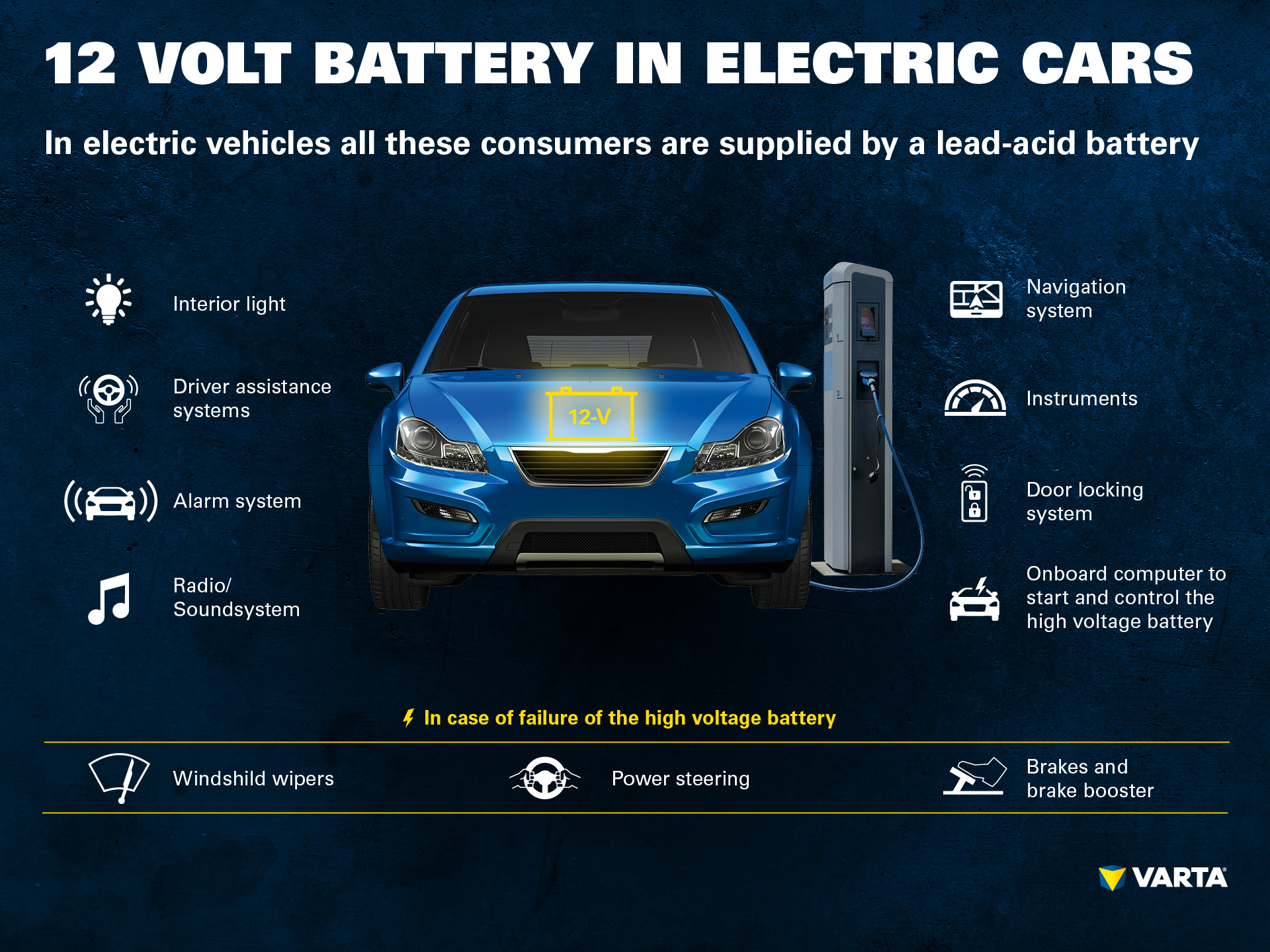
Have you ever wondered what happens when the lithium-ion battery in a modern electric or hybrid electric vehicle stops working? Look under the bonnet and you will find your answer. Alongside the high voltage lithium-ion traction battery you might find a second one: A 12 Volt battery acting as a second power source to ensure the uninterrupted function of safety critical systems, in case of a traction battery failure, but also key off-loads like the central locking system.
Car drivers today find that more and more comfort and safety features like lane assist, front assist or the proactive occupant protection are handled by onboard smart systems. The same goes for the majority of the car’s monitoring functions which are also operated by automatic control systems. This in turn increases the need for a reliable, high-performance power supply. VARTA® AGM and EFB batteries have proven their reliability in this regard for years, making them the perfect companion in supporting the 12 Volt electrical system of electric or hybrid electric vehicles.
Old but not old-fashioned
Lithium-ion batteries are considered the successor for lead-acid technology when it comes to the drivetrain of electric or hybrid electric vehicles. However, they are not as inherently robust as other rechargeable technologies and require continuous monitoring. Lithium-ion cells need protection from being overcharged and deep discharge. Additionally, they need to have the voltage maintained within safe limits, making a special protection circuitry mandatory. A further aspect of the protection circuitry is that the cell temperature needs to be monitored to detect and avoid critical malfunctions.
This is where already proven solutions like AGM and EFB play to their strengths. They step in when the high voltage battery fails or switches off, to lock and unlock the car and also serve as an additional power supply to buffer the electrical system. They ensure that important safety functions such as ABS and ESP are working at all times. AGM and EFB batteries are far from being obsolete. Their construction and behavior as well as their lack of electronics make them a reliable and robust power source.
The VARTA® 12 Volt battery portfolio is ready to support both today’s as well as future electric vehicles. They have sufficient spare capacity to reliably supply future consumers too. Our VARTA® Automotive batteries deliver energy for crucial safety systems, comfort features and fuel-saving functions. Today and tomorrow.
Find a trusted workshop
Do you work with batteries?
Deepen your knowledge
-
Construction of VARTA Promotive EFB Truck BatteriesA patented mixing element ensures that acid stratification cannot occur in our ProMotive EFB battery. Read our article now to find out exactly how this works and what advantages it brings.
-
The importance of charge acceptance of truck batteriesBatteries with high starting current (CAA) and sufficient capacity (C20) guarantee reliable fleet operation. We tell you why.
-
Battery tips for the leisure seasonGet ready for your journey. Discover helpful tips and tricks for your leisure battery to get the best start to the season