
Voltage stabilization during battery exchange
What is voltage stabilization?
Voltage stabilization describes the process of connecting an external power supply in order to maintain the voltage in the vehicle at a constant level when the battery is disconnected. This prevents the control units in the vehicle from registering a critical undervoltage and recording this as a fault in the event record.
“Mercedes sometimes reacts sensitively to this if you simply disconnect the battery and connect a new one: We already had a head up display that no longer works and problems with driver assistance systems. You have to use a diagnostic tool for that anyway. It could also affect the start/stop behaviour for a longer period of time.”
R. Nickel – CLARIOS Vehicle Application Engineer
Recommendation for voltage stabilization
The external power supply shall be connected before starting battery replacement or extended vehicle diagnostics.
NOTE: Never use a car battery charger to maintain voltage. Modern chargers use a special charging algorithm with different phases of charging. Sudden disconnection of the battery can lead to malfunctions in the charger, which can damage the vehicle electronics or charger.
When changing the battery, do not disconnect the installed battery until the external power supply has been connected and switched on.
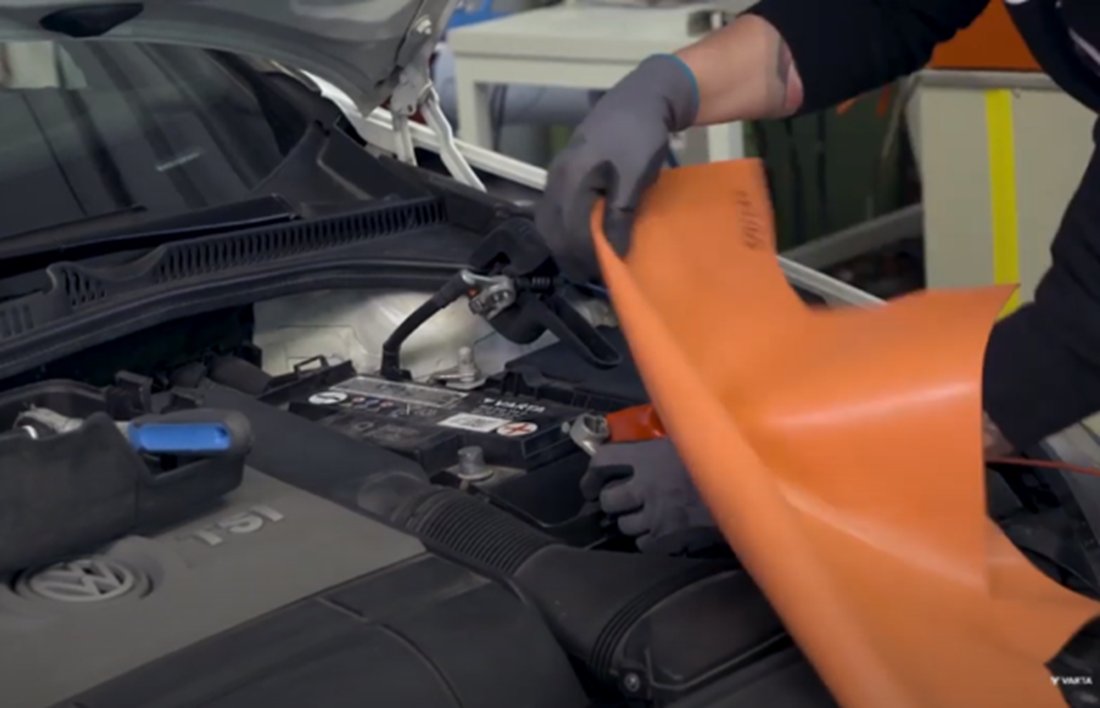
The external voltage source must always be connected at points that are capable of safely carrying the required currents. For this reason, we always recommend connecting the external voltage source to the battery connection terminals for diagnostic purposes.
In the event of a battery change, the connection to the battery terminals is naturally somewhat more difficult to handle. Working on the cables can also cause the clamps of the external voltage source to drop or cause short circuits. If available, we recommend using the jump start connection points in the vehicle in this case. Information on where these are in the vehicle can be found in the VARTA Partner Portal.
NOTE: We advise against connecting the voltage maintenance via the OBD interface. According to the ISO 15031-3 specification, the maximum current carrying capacity of the connections is limited to 10A - a value that can quickly be exceeded if several control units wake up. This can lead either to serious and expensive damage to the OBD interface or to the fuse being blown, unnecessarily delaying diagnostic or repair work.
The easiest way certainly is to use a second battery as a secondary power source. With this approach, it is important to make sure that the system is protected against unintentional short circuits by a suitable fuse.
In everyday workshop use, stationary constant power supplies with sufficient power from 350W have proven their worth. In this power class, even the unintentional wake-up of one or more control devices does not immediately lead to a breakdown of the supply voltage.
Conclusion
Whenever a battery change or an extensive troubleshooting needs to be performed an additional voltage stabilization should be ensured. Always try to connect the external power source to the battery connection terminals. If this is difficult to handle we recommend using the jump start connection points. Beware of short circuits. Never use a voltage maintenance via OBD. Better go with a secondary battery or a constant voltage power supply of at least 350W instead.
You want to learn more about the different electrical systems in modern vehicles? Then our Advanced Automotive Training is definitely the right thing for you!
Find a trusted workshop
Do you work with batteries?
Deepen your knowledge
-
Construction of VARTA Promotive EFB Truck BatteriesA patented mixing element ensures that acid stratification cannot occur in our ProMotive EFB battery. Read our article now to find out exactly how this works and what advantages it brings.
-
The importance of charge acceptance of truck batteriesBatteries with high starting current (CAA) and sufficient capacity (C20) guarantee reliable fleet operation. We tell you why.
-
Battery tips for the leisure seasonGet ready for your journey. Discover helpful tips and tricks for your leisure battery to get the best start to the season